Gap 1: Identity and access visibility
Your identity data likely lives across several directories and cloud tenants, with each source holding only part of the picture. Directory migrations and acquisitions are natural opportunities to bring those sources into one view.
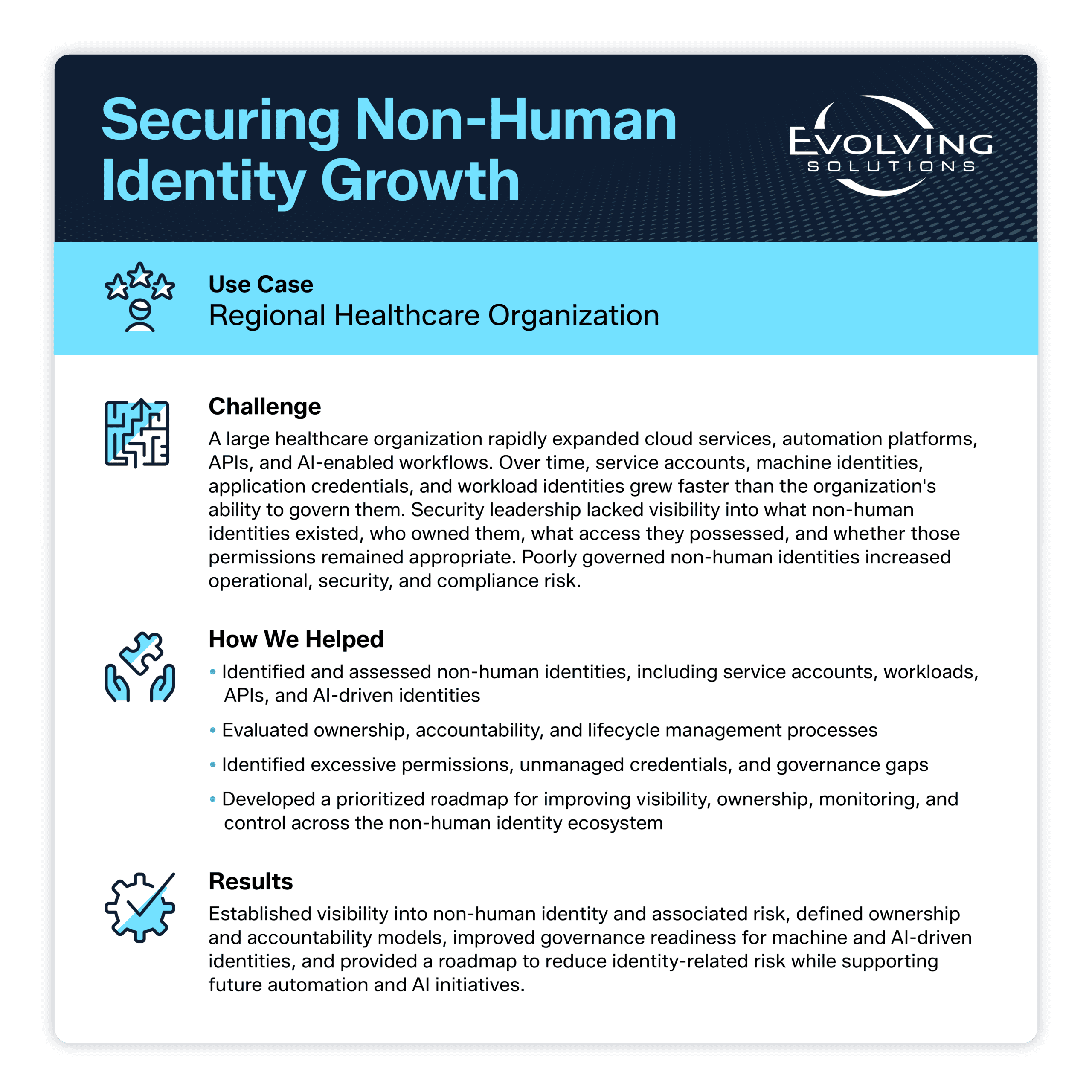
Where to start: Export read-only data from each identity source and map every identity to an owner. This creates the baseline you’ll need for future decisions.
Gap 2: Non-human identity ownership
Service accounts and secrets can easily outlive the projects that created them, allowing ownership and rotation practices to drift over time. Assigning clear ownership gives you the control needed to rotate credentials and retire identities safely.
Where to start: Begin with non-human identities that have the broadest access. Assign each one a named owner, then establish a rotation standard for every credential type.
Gap 3: AI agent authority
AI agents often inherit the permissions of the user or service that launched them – potentially giving them more access than you intended. Defining authority per agent and per task helps you keep each agent’s reach aligned with its purpose.
Where to start: Register each agent as its own identity, assign a named owner, and limit permissions to the task. Use short-lived credentials that expire when the work ends.
Gap 4: Governance coverage
Your governance program may center on periodic certifications while joiner-mover-leaver events still rely on manual steps. Extending governance across the lifecycle helps you keep audit and compliance evidence current between review cycles.
Where to start: An audit finding tied to access is a practical starting point. Automate lifecycle events using your authoritative HR source, then focus certifications on the higher-risk access that remains.
Gap 5: Access that adapts to risk
Access granted for a project or role change often remains long after the need ends. Combining just-in-time access with identity threat detection can help you adjust privileges as your people, projects, and risks change.
Where to start: Use your next identity platform renewal to assess which existing contracts already support just-in-time access and where you may need additional capabilities.
Evolving Solutions measures each organization’s identity program across its logical and technical design, including existing contracts and renewal timing. Every recommendation is sequenced into a plan the organization can fund and execute.
Explore identity security at Evolving Solutions